
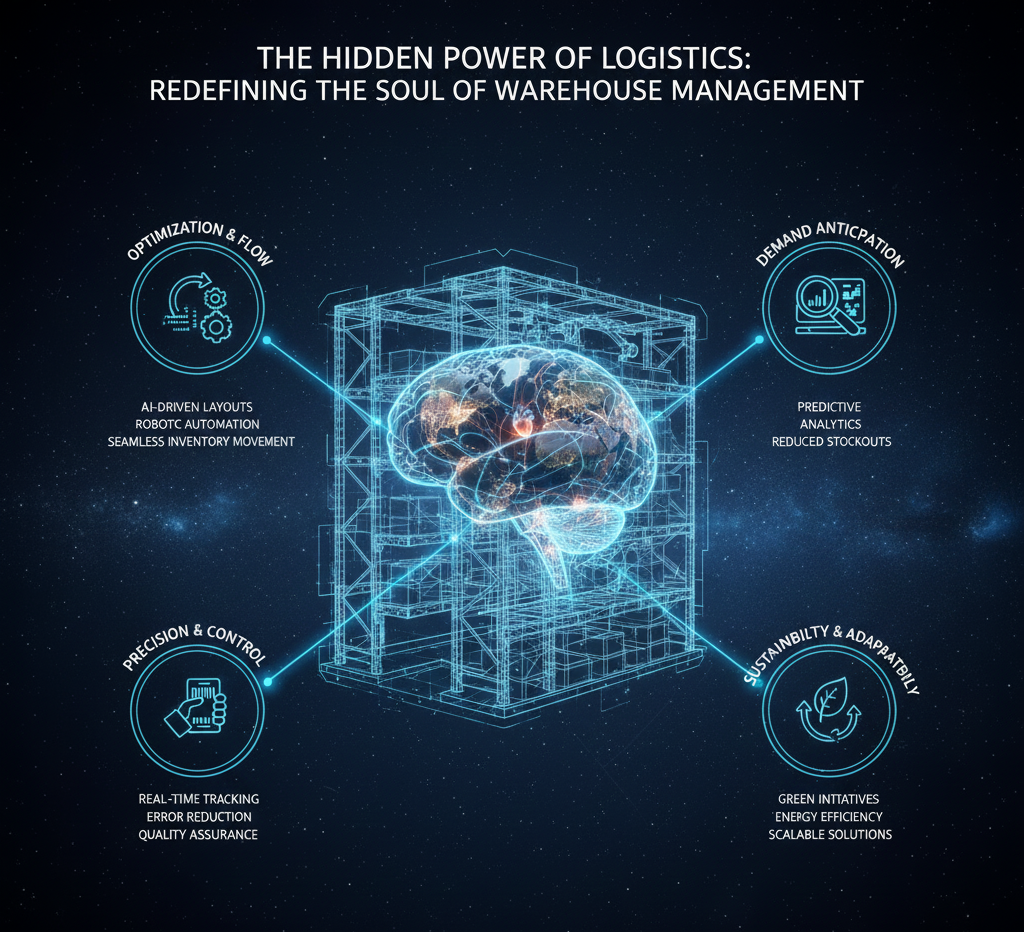
Introduction: When Warehouses Learned to Feel
Once upon a time, warehouses were nothing more than silent containers of goods. They stood still, cold and functional, designed only to store and wait. However, as the world began to move faster, something remarkable happened. Warehouses started to feel alive.
Today, logistics has transformed warehouse management into something deeper and more human. Instead of being lifeless spaces, warehouses have become emotional engines of movement, coordination, and trust. In many ways, logistics has given them a soul.
Logistics: The Invisible Hand Guiding Every Movement

At first glance, logistics hides in the background. Yet, without it, nothing moves forward. Every product you touch, every delivery you receive, and every promise kept on time is guided by logistics working quietly behind the scenes.
Moreover, logistics connects the dots between suppliers, warehouses, and customers. As a result, warehouse management is no longer about stacking boxes. Instead, it is about managing flow, timing, and reliability with precision and care.
The Warehouse Is No Longer a Place—It’s a Pulse
Rather than being static destinations, modern warehouses function like beating hearts. Goods arrive, pause briefly, and then move on with purpose. Consequently, every inbound shipment feels like a heartbeat, while every outbound order resembles a breath released into the market.
Because of this rhythm, warehouse management now depends on balance. When flow is smooth, operations feel effortless. When flow is disrupted, tension rises quickly.
Warehouse Management as a Living Organism

From Static Storage to Flowing Energy
In the past, warehouses behaved like locked vaults. Today, however, they resemble rivers. Inventory flows continuously, guided by logistics decisions that shape direction and speed.
Too much inventory creates pressure. On the other hand, too little causes drought. Therefore, logistics teaches managers how to guide movement instead of blocking it.
When Processes Start to Think
Processes were once rigid and repetitive. Now, they are flexible and intelligent. With the help of logistics systems, warehouses learn from every action.
Each scan tells a story. Each delay offers a lesson. Over time, the warehouse evolves, becoming smarter with every decision made.
The Emotional Intelligence of Logistics
Anticipation Over Reaction
Strong logistics does not wait for problems to appear. Instead, it anticipates them. By forecasting demand and identifying patterns early, warehouse managers stay ahead of disruption.
As a result, anticipation replaces panic. Calm replaces chaos. This emotional intelligence defines high-performing warehouse operations.
Listening to What Data Is Saying
Although data is numerical, its message is emotional. For instance, a rise in returns may signal customer dissatisfaction. Likewise, frequent errors may reflect fatigue or poor layout.
Therefore, logistics is about listening carefully. When data speaks, wise managers respond with empathy and action.
Technology as the Nervous System of the Warehouse
WMS, Automation, and Digital Memory
Warehouse Management Systems act like memory. They remember movements, locations, and patterns so people can focus on judgment and leadership.
Meanwhile, automation removes unnecessary strain. Rather than replacing humans, technology supports them by reducing friction and increasing accuracy.
When Machines Learn Rhythm
Technology performs best when it follows human rhythm. Fast where speed matters. Gentle where precision is required. Consequently, the most successful warehouses feel harmonious, not robotic.
People: The Soul Inside the Steel Walls
Despite all advances, people remain the heart of logistics. Their intuition, experience, and pride cannot be automated.
Pickers, supervisors, planners, and drivers carry invisible knowledge. When they are supported, warehouses thrive. When they are ignored, even the best systems fail.
Leadership That Moves Like Logistics
Warehouse leadership is not about control; instead, it is about flow. Effective leaders remove obstacles, align teams, and create clarity.
Furthermore, calm leadership spreads quickly. When leaders move with intention, operations follow naturally.
Redefining Performance Through Human Experience
Ergonomics, Safety, and Dignity
Efficiency should never come at the cost of dignity. A well-designed warehouse respects the human body and protects well-being.
When people feel safe, respected, and valued, productivity increases without force.
Motivation as an Invisible Accelerator
Motivation fuels everything, even though it cannot be measured easily. Recognition, trust, and opportunity act as invisible accelerators within warehouse management.
As a result, motivated teams outperform even the most advanced systems.
Sustainability: Giving the Warehouse a Conscience
Green Logistics as a Responsible Choice
Sustainability has become a necessity. Warehouses consume energy and space, which makes logistics decisions critical.
By optimizing layouts and reducing unnecessary movements, warehouses lower their environmental impact.
Less Waste, More Purpose
Every wasted movement drains energy. Every unused pallet represents lost potential. Sustainable logistics turns efficiency into responsibility and purpose.
The Future Warehouse: Predictive and Alive
Looking ahead, warehouses will predict demand before it arrives. They will adapt layouts automatically and balance workloads intelligently.
Yet, the most important evolution will be philosophical. Warehouses will no longer be seen as costs, but as creators of value.
Logistics as a Competitive Advantage
Speed, reliability, and transparency define modern competition. Logistics transforms warehouse management into a strategic weapon.
Because of this, companies that invest in logistics win trust and loyalty.
From Cost Center to Value Creator
Warehouses were once viewed as unavoidable expenses. Now, they are powerful assets.
With the right logistics strategy, warehouse management increases agility, customer satisfaction, and long-term growth.
Why the Soul of Logistics Matters More Than Ever
In a world driven by urgency, logistics brings balance. In a world ruled by data, it restores humanity.
Ultimately, logistics reminds us that movement without meaning is empty.
Conclusion: When Logistics Becomes Legacy
The true power of logistics lies not in machines, but in meaning. When warehouse management embraces its soul, it transforms operations into impact.
Through rhythm, respect, and responsibility, logistics delivers more than goods—it delivers trust. And in that quiet consistency, logistics becomes legacy.